NBA “3-2-1 Lottery”
On April 28, ESPN reported new details regarding a proposed reform of the NBA Draft lottery. The proposal, referred to as the “3–2–1 lottery,” aims to discourage teams from tanking by adjusting the teams’ probability of receiving the top picks. The Proposal modifies both the number of participating teams and the allocation of lottery odds.
The "3-2-1 lottery" proposal, named to represent the number of lottery balls per team, would expand the lottery from 14 to 16 teams. Teams that do not qualify for the playoffs or play-in tournament but stay out of the relegation zone (spots four through 10) would receive three lottery balls each. Teams with a bottom-three record -- the relegation area -- would have only two lottery balls but have a floor of the No. 12 pick, and the rest of the 13 lottery teams could fall as far as the No. 16 pick.
The Nos. 9 and 10 play-in seeds in each conference receive two lottery balls each, and the losers of the 7-8 play-in games receive one lottery ball each.
This proposal has been criticized for being punitive towards the team with three worst records (“the Bottom Three”) who are given only two lottery balls each. However, the crux of biscuit is in how the Top-12 guarantee is implemented in practice. At the time of writing, no procedural details have been publicly specified.
The guarantee can be implemented in many ways, for example, by using a Hard Boundary method or by using an Accept/Reject approach.
Update: On May 11, Zach Lowe mentioned on his podcast “The Zach Lowe Show” that there has been discussions of implementing the draft lottery using Reverse Elimination:
[…] And there's a world in which they actually draw from 16 to 1 in reverse order. And the way that would work is process of elimination. So if you're one of the teams that has three balls and your ball comes up for the 16th pick, that doesn't mean you get the 16th pick. That means you have two balls left in the kitty. They draw again for the 16th pick. And the first team that has like one, that's their last ball, they get the 16th pick and you go from there.
In other words, the Reverse Elimination lottery would start at No. 16 pick, and the team that first runs out of balls would always get the next pick. The Bottom Three teams would be included when the pick No. 13 has been decided. The probability table resulting from this implementation would significantly favor the Bottom Three.
Update: On May 22, Kevin O’Connor reported more details about the proposed lottery reform. The report concentrated on the rules related to consecutive draft lotteries, but the wording in the following passage could also be applied to the Top-12 guarantee:
“In the event a team's pick is drawn in the lottery in a position where it is not permitted to be, then such team’s pick would be moved down to the first permissible position,” the league wrote in its proposal sent to teams.
In the context of Top-12 guarantee, this would lead to an Accept/Correct approach where the Bottom Teams falling lower than twelfth would be moved up so that they are guaranteed Top 12 pick. In practice, this approach would yield results identical with the Hard Boundary method.
In the following we will see that the implementation of the guarantee actually determines the entire structure of the probability table describing the pick probabilities.
Final Update: On May 28, the Board of Governors approved a new NBA Draft Lottery system. The press release did not mention the method used for implementing the Top-12 guarantee, but it included a link to a document presenting an “Illustrative Odds Distribution”.
Additional information regarding the new system, including the lottery odds distribution, can be found here.
The presented odds distribution matches with the Hard Boundary method which would implicitly mean that the picks are selected one at at time and the Bottom Three teams are injected into the selection order before No. 12 pick, if necessary.
Hard Boundary Method
In the Hard Boundary method, the teams are selected one at a time until nine picks have been determined. After the first nine selections, any remaining Bottom Three teams are assigned picks no lower than No. 12 using a random tie-breaking mechanism. For example, if two of the Bottom Three are still without a pick when ten picks have been drawn, the two teams flip a coin to determine who gets No. 11 pick and who is pushed to No. 12 pick.
The results of a Monte Carlo simulation of the Hard Boundary method (with 1,000,000 simulation replications) are presented below.
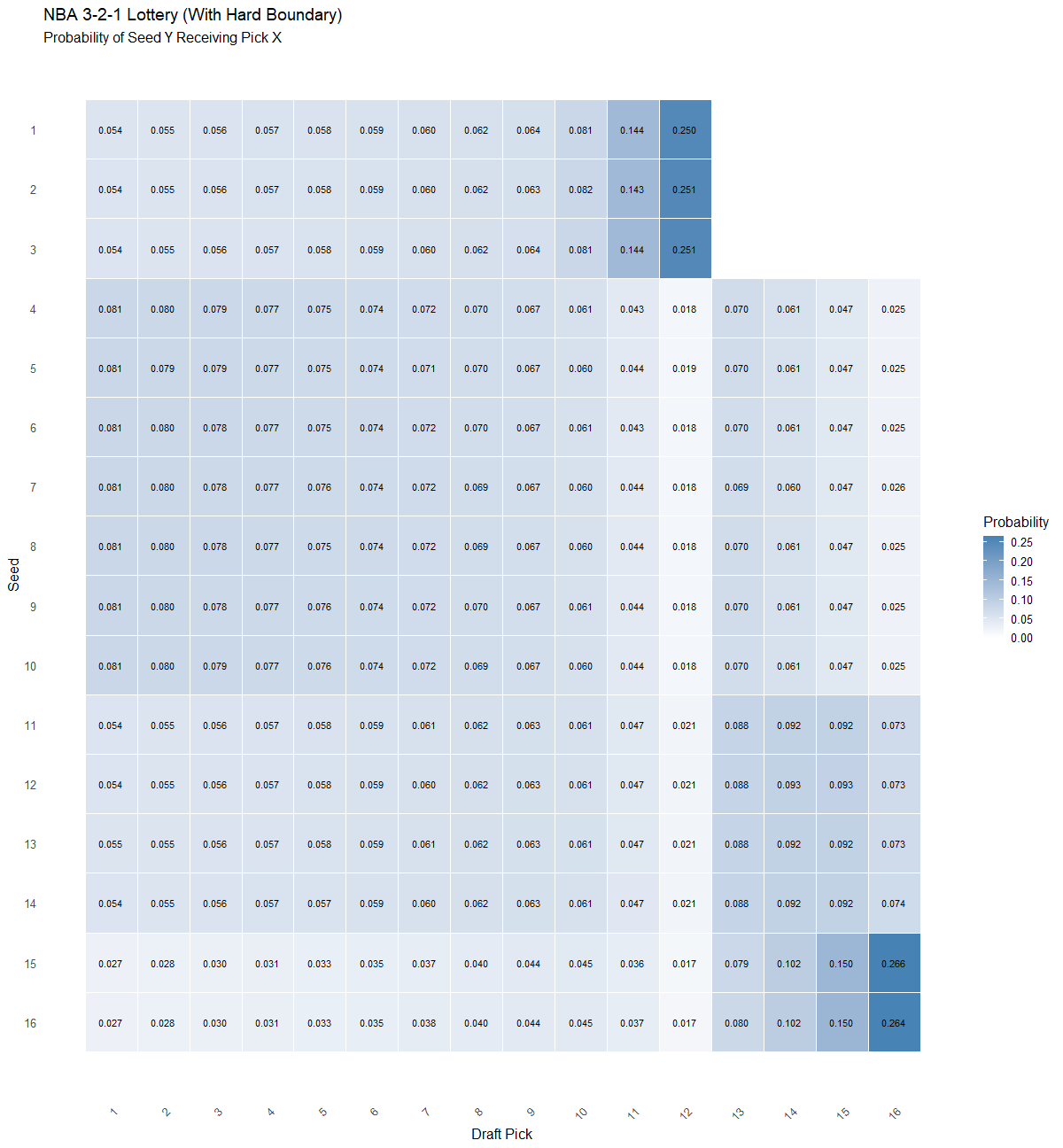
Monte Carlo simulation results for the NBA 3-2-1 Lottery with Hard Boundary.
The simulation indicates that the Hard Boundary implementation substantially disadvantages the Bottom Three teams. Because they have only two lottery balls in the drawing, each Bottom Three team has approximately a 5.4% probability of receiving the first overall pick, compared to 8.1% for teams seeded 4–10. Moreover, there is roughly a 25% probability that a Bottom Three team is pushed all the way back to the pick No. 12.
Accept/Reject Approach
In the Accept/Reject approach, the lottery balls are drawn to first determine the entire draft order. Then, the draft order is checked to see if any of the Bottom Three have fallen below No. 12 pick. If this is the case, the entire draft order is rejected and all picks are determined once again. This is repeated until an acceptable draft order is found.
The results of a Monte Carlo simulation of the Accept/Reject approach (10,000,000 replications, out of which 3,470,244 were accepted) are presented below.
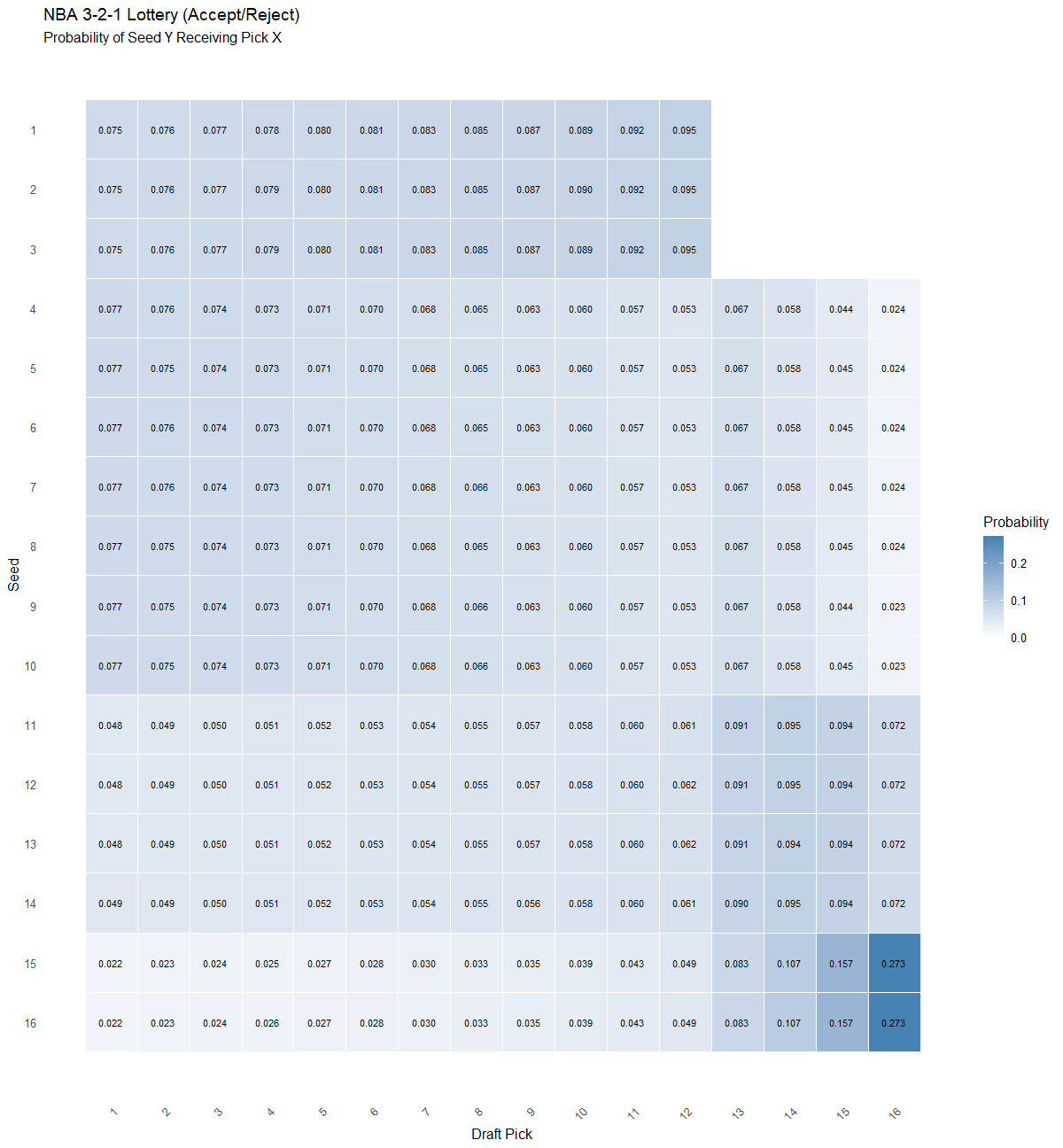
Monte Carlo simulation results for the NBA 3-2-1 Lottery with Accept/Reject Approach.
The first observation from the Monte Carlo simulation is that 65% of the randomly generated draft orders were rejected because they did not fulfill the Top 12 guarantee for the Bottom Three. Compared to the Hard Boundary method, these were the situations were at least one of the Bottom Three teams was pushed beyond the boundary line.
The second observation of the results is that this method is far less punitive compared to the first alternative. The Bottom Three teams have approximately the same odds for getting top picks as the teams seeded in the 4-10 range. In other words, the Bottom Three teams only having two lottery balls is almost completely compensated by the Top-12 guarantee.
Notably, the expected draft position for Bottom Three teams is 6.8, compared to 7.7 for teams seeded 4–10, indicating a slight advantage instead of a penalty.
Reverse Elimination Method
In the Reverse Elimination method, the picks are decided in reverse order starting from No. 16 pick. The balls for teams seeded between four and sixteen are placed in the machine. Balls are drawn at random and when a team runs out of balls in the machine, they get the next pick. The balls for the Bottom Three teams are added into the machine when No. 13 pick has been decided which implements the Top-12 guarantee for the Bottom Three teams. The process continues until only one team has balls in the machine and gets the No. 1 pick.
The results of a Monte Carlo simulation of the Reverse Elimination Method (1,000,000 replications) are presented below.
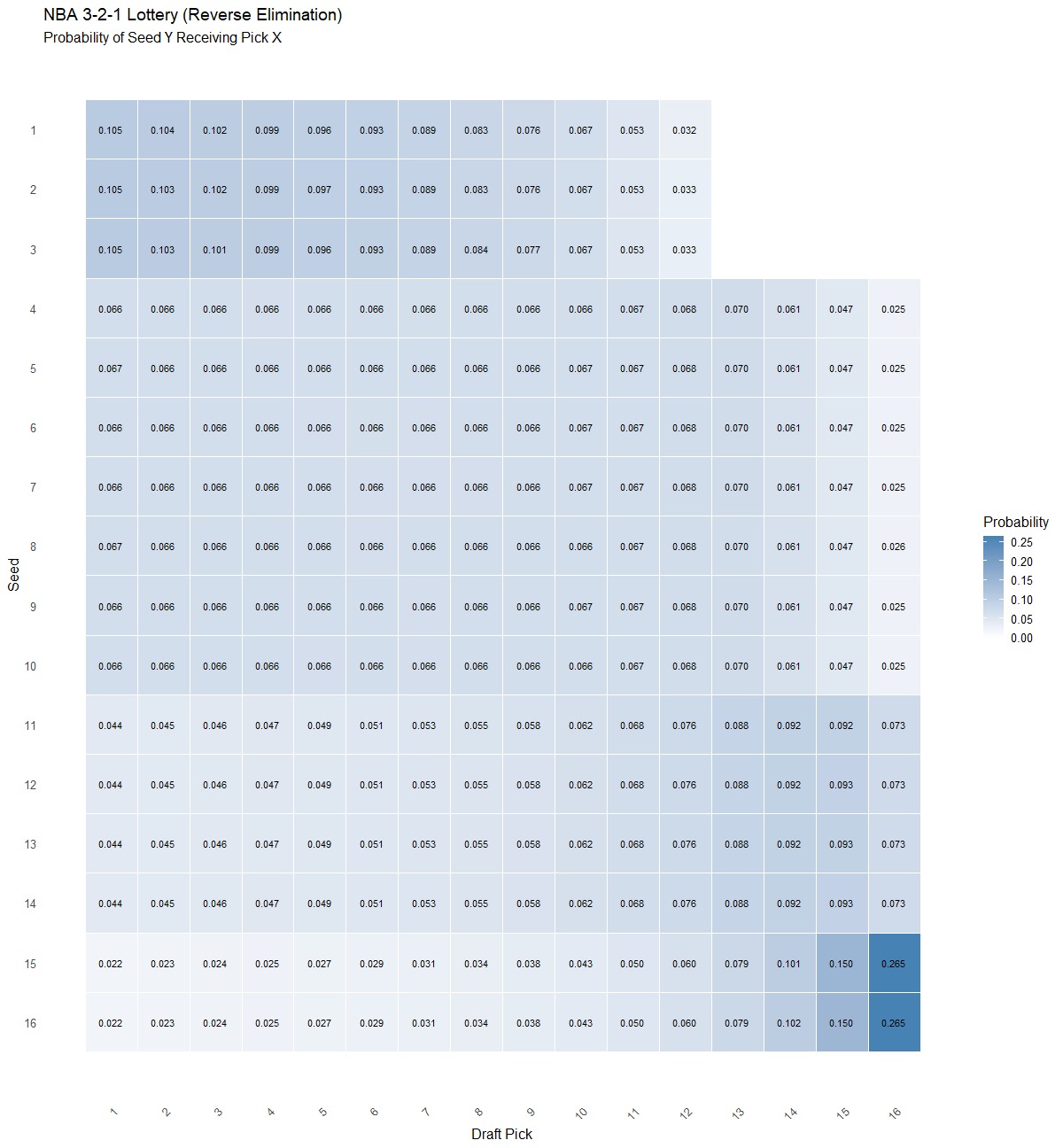
Monte Carlo simulation results for the NBA 3-2-1 Lottery with Accept/Reject Approach.
The probability table shows that this implementation would heavily favor the Bottom Three teams. The intuition is that the teams with three balls in the machine are likely to lose some of their balls even before the balls for Bottom Three are included. This would give the Bottom Three teams approximately 10% of getting each of the five picks compared to the 6.7% chances given to the teams seeded 4-10.
In other words, this version of the “3-2-1 lottery” would not remove the incentive to tank for the Bottom Three seeding in the lottery.
Accept/Correct Approach
In the Accept/Correct approach, the lottery balls are drawn to first determine the entire draft order. Then, the draft order is checked to see if any of the Bottom Three have fallen below No. 12 pick. If this is the case, the problem is corrected by moving the Bottom Three teams up so that their relative order holds and they all above No. 13. pick.
The results of a Monte Carlo simulation of the Accept/Correct approach (1,000,000 replications) are presented below.
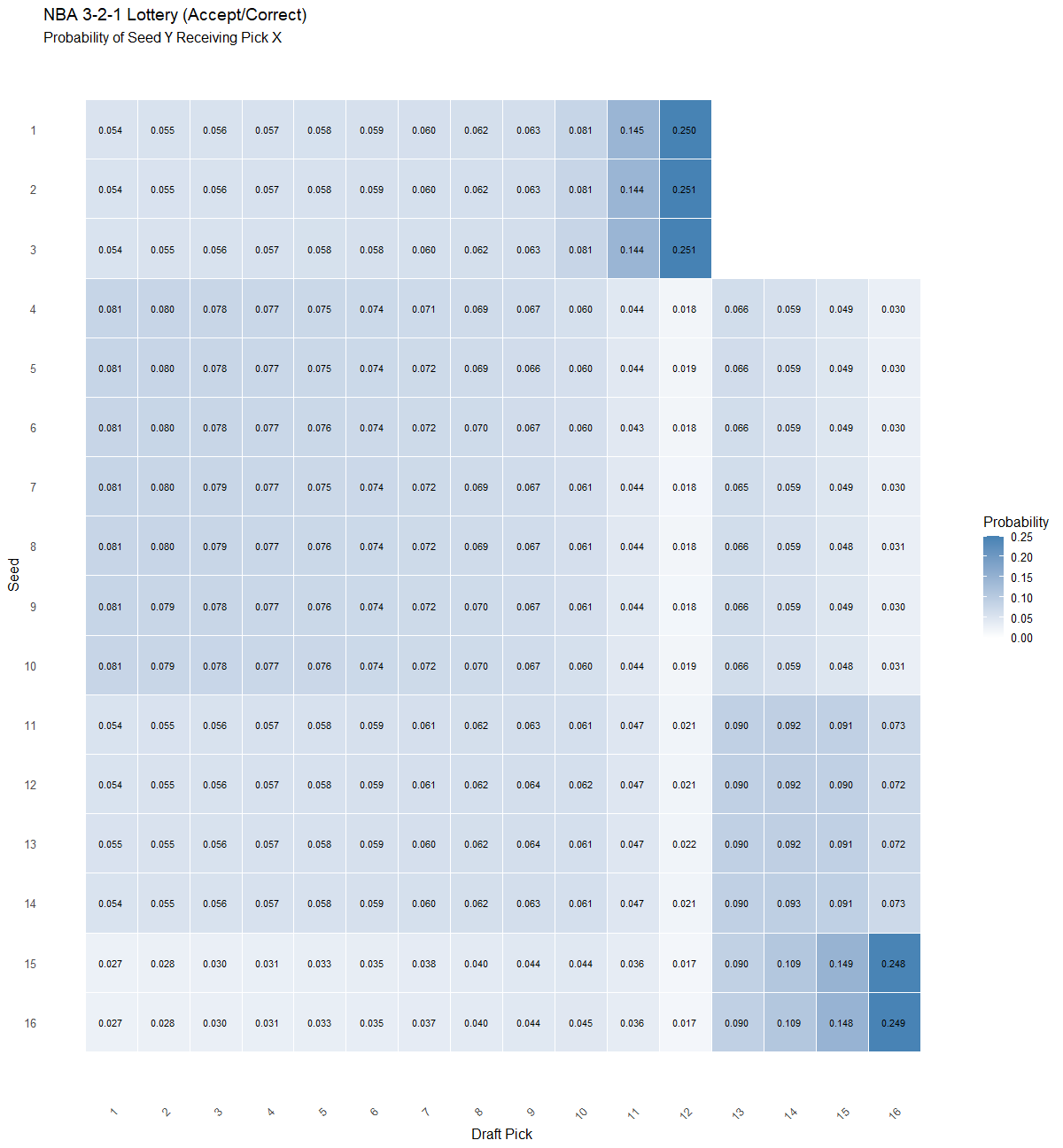
Monte Carlo simulation results for the NBA 3-2-1 Lottery with Accept/Correct Approach.
The resulting probability distribution for Bottom Three teams is identical with the Hard Boundary method. Therefore, the Accept/Correct approach is found to disadvantage the Bottom Three teams and there is roughly a 25% probability that a they are pushed to the pick No. 12.
Interestingly, the columns representing picks No. 13 through 16 are not identical with the Hard Boundary method. That is, the Accept/Correct approach slightly benefits the teams with less than three lottery balls (seeds 11-16) over the teams with three balls (seeds 4-10). However, this effect is marginal at best.
Conclusion (updated on May 28)
The analysis demonstrates that the impact of the proposed “3–2–1 lottery” depends critically on the implementation of the Top-12 guarantee. When considering potential tanking boundary near the Bottom Three of the standings, the same allocation of lottery balls can produce either a strongly punitive, nearly neutral, or heavily favorable outcome for the teams landing in the Bottom Three.
In particular:
Both the Hard Boundary method and the Accept/Correct approach introduce a significant downward bias and punish teams for falling into the Bottom Three.
The Accept/Reject approach largely offsets the reduced number of lottery balls.
The Reverse Elimination method favors the Bottom Three teams and would not remove the incentives for tanking.
Consequently, any evaluation of the proposal remains incomplete without explicit procedural details. One should hold judgment before the implementation mechanism is specified, as it effectively determines the resulting probability structure.
Final Update: Based on the lottery odds published by the NBA on May 28, the Hard Boundary method was selected and the Bottom Three teams are very likely to fall to the picks ranging from No. 10 to No. 12.